21 July 2023
Running in the Heat

Running is a popular and effective way to maintain physical fitness and improve cardiovascular health. However, running in the heat, especially during the summer months, can pose significant challenges and risks to runners. Heat stress can affect a runner’s performance, health, and safety. Let’s explore the effects of heat on runners, the physiological changes that occur, and various strategies to mitigate the risks associated with running in the heat.
The Effects of Heat on Runners
Running in hot and humid conditions can make it harder for the body to cool itself, leading to an increase in core temperature. As body temperature rises, the body’s thermoregulatory mechanisms can become overwhelmed and the body’s cooling mechanisms, such as sweating and blood flow to the skin, become less effective. This can lead to dehydration, heat exhaustion, and even heatstroke.
Research suggests that runners start to experience a decline in performance at temperatures above 60°F (15.6°C) (Racinais et al, 2015), with most runners experiencing a decrease in performance between 60-70 °F (15-21°C). For every 1°C increase in temperature above this threshold, running performance decreases by 1-2% (Gonzalez-Alonso et al, 1999). And in temperatures over 25°C you can lose 10 seconds per mile. This is mainly because:
- As the temperature increases, the body has to work harder to cool itself down, which can lead to increased heart rate and fatigue, which reduces performance. This is exacerbated in direct sunlight.
- High humidity adds an extra burden as the body can no longer cool down as well through sweating. When the air is humid, sweat does not evaporate as quickly, leading to increased discomfort and reduced performance.
- Sweating increases to regulate body temperature, which can lead to loss of fluids, dehydration , electrolyte imbalances, and other heat-related ailments, all of which can negatively impact performance.
- The risk of injury can also increase due to reduced muscle function and coordination.
To be more specific, when running in the heat, the body undergoes several physiological changes to maintain homeostasis and prevent hyperthermia. The hypothalamus, a part of the brain, acts as the body’s thermostat and regulates core body temperature. The hypothalamus signals the sweat glands to produce sweat, which evaporates and cools the skin. Blood vessels in the skin dilate, allowing more blood flow to the surface, which facilitates heat loss. The heart rate increases to circulate more blood to the skin and muscles.
However, when the body’s cooling mechanisms become overwhelmed, core temperature can rise, leading to hyperthermia. Symptoms of heat exhaustion to take note of include weakness, dizziness, nausea, headache, and fainting. In severe cases, heatstroke can occur, which is a medical emergency that requires immediate attention. Heatstroke can cause confusion, seizures, loss of consciousness, and even death.
This is is important to consider when racing in these conditions. It’s tough, and it needs to be recognised that you will be slower, and it will be unlikely that you can achieve a personal best. Research shows that marathon runners are more likely to experience heat-related illness when racing in hot conditions (Roberts et al., 2010). This is because during a race, intensity and heart rate are already raised and the body has extra to deal with.


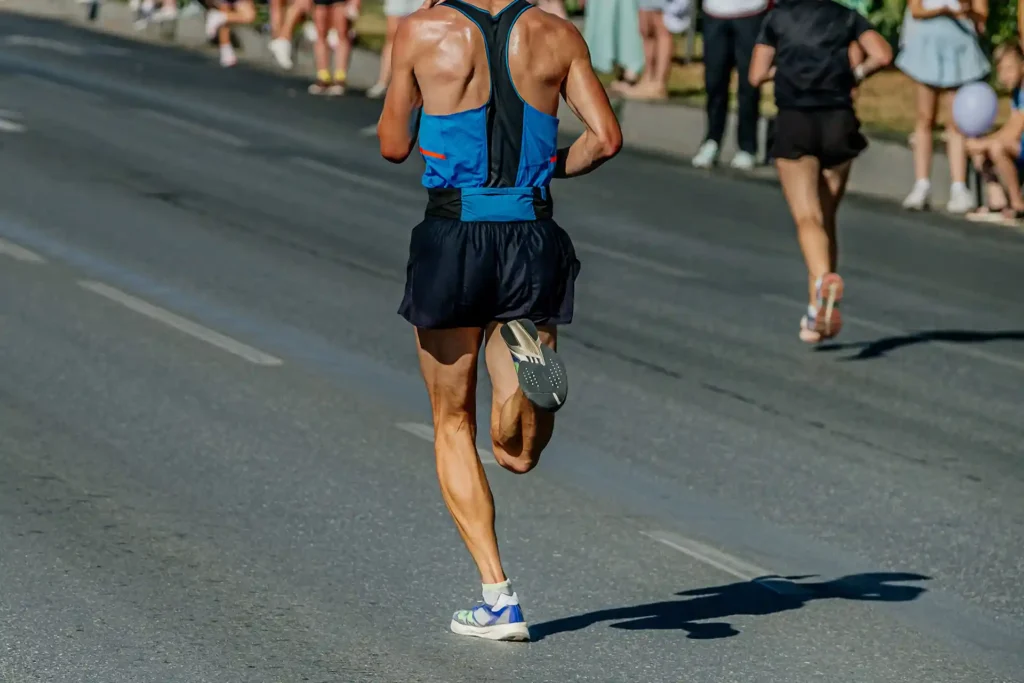
During a race, it is essential to monitor one’s hydration status and to drink fluids regularly to prevent dehydration. As a rule of thumb, you should be sipping water / water with electrolytes every 5km but in heat this reduces to 3km or less.
In recent years, several high-profile cases of hyperthermia have occurred during long-distance running events. For example, during the 2018 Boston Marathon, temperatures reached 77°F (25°C), and nearly 2,000 runners required medical attention, with some experiencing hyperthermia (Associated Press, 2018). These cases highlight the importance of taking precautions when running in the heat and being aware of the signs and symptoms of hyperthermia.
Strategies to Help
- Good Nutrition and Hydration
Proper nutrition and hydration are critical for runners running in the heat. Runners should aim to drink fluids regularly, preferably water or sports drinks that contain electrolytes. The American College of Sports Medicine recommends consuming 14-22 ounces of fluids 2 hours before exercise and 6-12 ounces every 15-20 minutes during exercise in temperatures over 82°F (28°C) (Sawka et al., 2007). Another to think about it is approximately every 3km. It is also important to consume good carbohydrates before and during exercise to maintain energy levels and prevent fatigue.
- Appropriate Clothing
Wear light colored, breathable, and sweat-wicking clothing that allows for good air circulation to help keep you cool.
Lightweight and breathable clothing can help facilitate heat loss by allowing sweat to evaporate from the skin. Dark-colored clothing can absorb more heat from the sun, while light-colored clothing reflects heat and can help reduce the effects of solar heating.
Wearing a hat or visor and UV-blocking sunglasses can also help protect the face and eyes from the sun.
- Slow down
Slow down your pace and reduce your intensity to avoid overheating and fatigue. Listen to your body and adjust your pace accordingly. It can be tough to accept but you are not going to be setting any PB’s in high temperatures so try to focus more on the enjoyment of running or racing (something you can’t often do when racing 😜) and get round safely.
In training, take rest breaks as needed, and consider running shorter distances or reducing your overall mileage when temperatures are high.
Cooling Strategies
Cold drinks, ice drinks or ice lollies can help lower core temperature and prevent dehydration
Use of cold, wet towels, ice packs, cooling vests can help lower core temperature. Consider using a hat or bandana
Run in shaded areas, and / or consider avoiding running during the hottest times of the day (unless you are heat adaptation training, see below).
Consider running indoors on a treadmill or in an air-conditioned gym
Use sunscreen to protect your skin from the sun’s harmful rays, which can contribute to overheating and dehydration
Clothing, pacing and nutrition / hydration as above
Train for the heat
If you know you are going to racing or training in high temperatures, the most important intervention to reduce the physiological strain and optimise performance is to heat acclimatise. Heat acclimatisation will lower the physiological strain for competition, improve their exercise capacity, increase sweat production and produce an earlier onset of sweating. It is recommended to gradually increase exposure to heat and humidity during training to allow the body to adapt safely. It should comprise repeated exercise-heat exposures over 1-2 weeks leading to competition (Racinais et al, 2015).
Use of hot rooms, saunas, clothing in warm weather can be utilised to create various micro-climates. Regular exercise in temperate conditions can elicit a partial heat acclimatisation but it cannot replace consecutive days training in heat (Armstrong and Pandolf, 1988), so time to head out in the afternoon sun! Most adaptations take place in the first week of heat acclimatisation and more slowly in the second week, with highly trained athletes developing more quickly.
The time it takes to adapt to the heat varies among individuals and depends on factors such as the frequency and intensity of heat exposure. Research suggests that it can take 7-14 days of heat exposure to achieve significant adaptations (Garrett et al., 2012). However, full adaptation can take up to 3-4 weeks.
Conclusion
Running in the heat can be a challenge, but with proper precautions and strategies, runners can minimise the risks and enjoy their sport safely. It is important to monitor one’s hydration status, wear appropriate clothing, and be aware of the signs and symptoms of heat-related illness. Gradual exposure to heat and humidity during training can help the body adapt to hot conditions, improving performance and reducing the risk of heat-related illness.
SIGN UP To Elite Formula Physio & Training
Welcome to Elite Formula Physio & Training, where you can experience exclusive, personalized coaching in performance and physiotherapy-typically reserved for professional athletes. Our team, led by Bradley Scanes, a renowned Human Performance Consultant at Red Bull Racing & Red Bull Technology, brings a wealth of expertise to ensure the utmost care for our clients.
Meet the experts behind our success: Matt Murray-Downing, a Formula 2 Physiotherapist and Performance Coach, and Grace Covington, a seasoned Physiotherapist for the England Women’s Rugby Team. Both specialists contribute their unique knowledge and experience to our approach.
At Elite Formula PT, we are committed to tailoring programs that address the specific needs and aspirations of each individual. Whether you seek to improve athletic performance or recover from an injury, our team possesses the necessary expertise to guide you towards success. Join us and unlock your full potential!